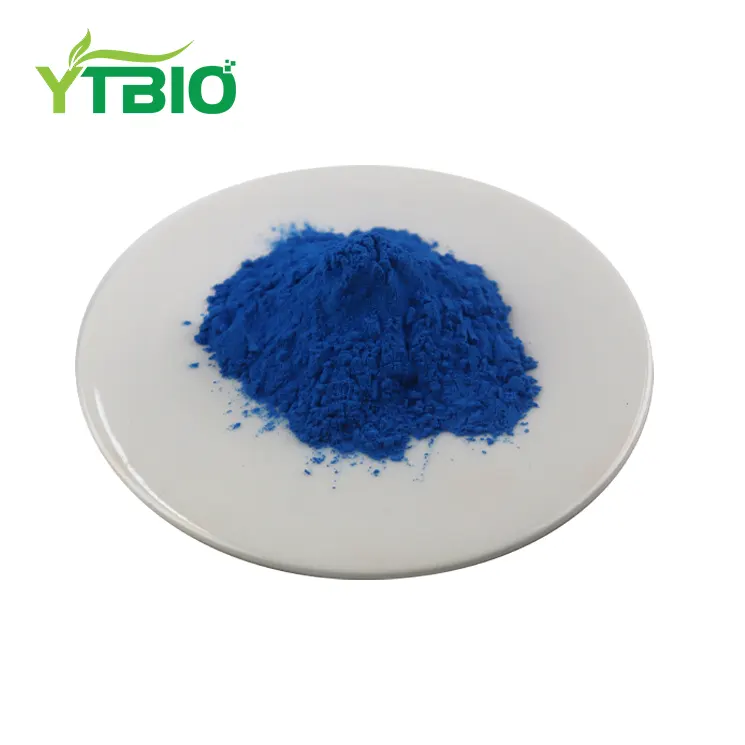
Copper Peptide GHK Cu Powder
Assay:≥99%
Appearance:Blue to Purple Powder
Note: Not for personal sale
Storage conditions: This product should be sealed and shaded, stored in a dry
Certifications:ISO9001,ISO22000,Kosher,Halal,FSSC22000
Shipping speed:3-5 days
- Fast Delievery
- Quality Assurance
- 24/7 Customer Service
Product Introduction
What is GHK-Cu?
GHK-Cu/Copper Peptide GHK Cu Powder (Glycyl-L-Histidyl-L-Lysine Copper Complex), also known as blue copper peptide, is a bioactive small molecule formed by the complexation of a glycine-histidine-lysine tripeptide with copper ions. With a molecular weight of approximately 340 Da, GHK-Cu can penetrate the stratum corneum and enter the dermis. Through copper ions acting as a cofactor, it activates fibroblasts, promoting the synthesis of type I, III, and IV collagen, elastin, and proteoglycans. Simultaneously, it upregulates vascular endothelial growth factor, accelerates wound healing, and inhibits matrix metalloproteinase activity, reducing collagen degradation. Due to its multiple effects of anti-wrinkle, firming, repair, and anti-photoaging, GHK-Cu is widely used in anti-aging serums, eye care, and post-operative repair products.
.png "640 (2).png")
Why Choose YTBIO's GHK-Cu?
Our high-purity GHK-Cu (≥99%) meets both cosmetic and pharmaceutical raw material standards.
YTBIO supports customized liposome formulations, significantly improving the transdermal absorption rate and formula stability of copper peptides in creams and serums.
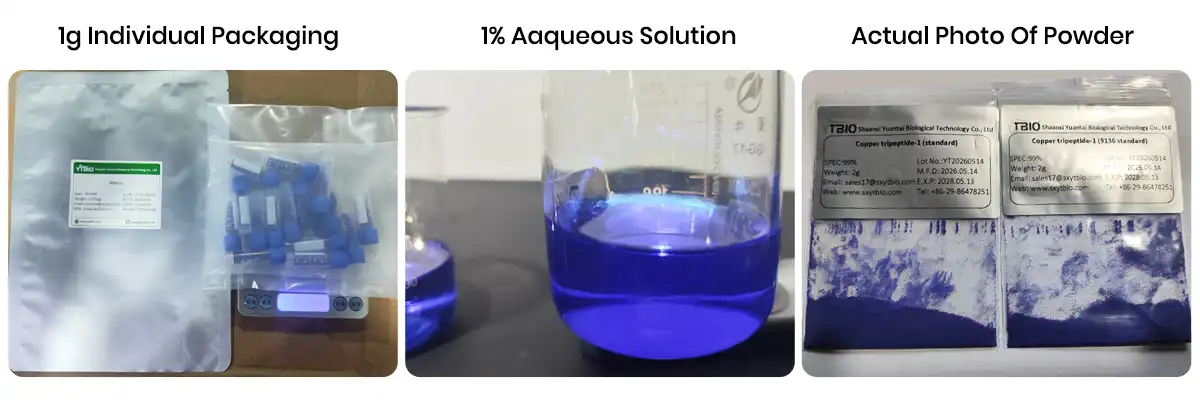
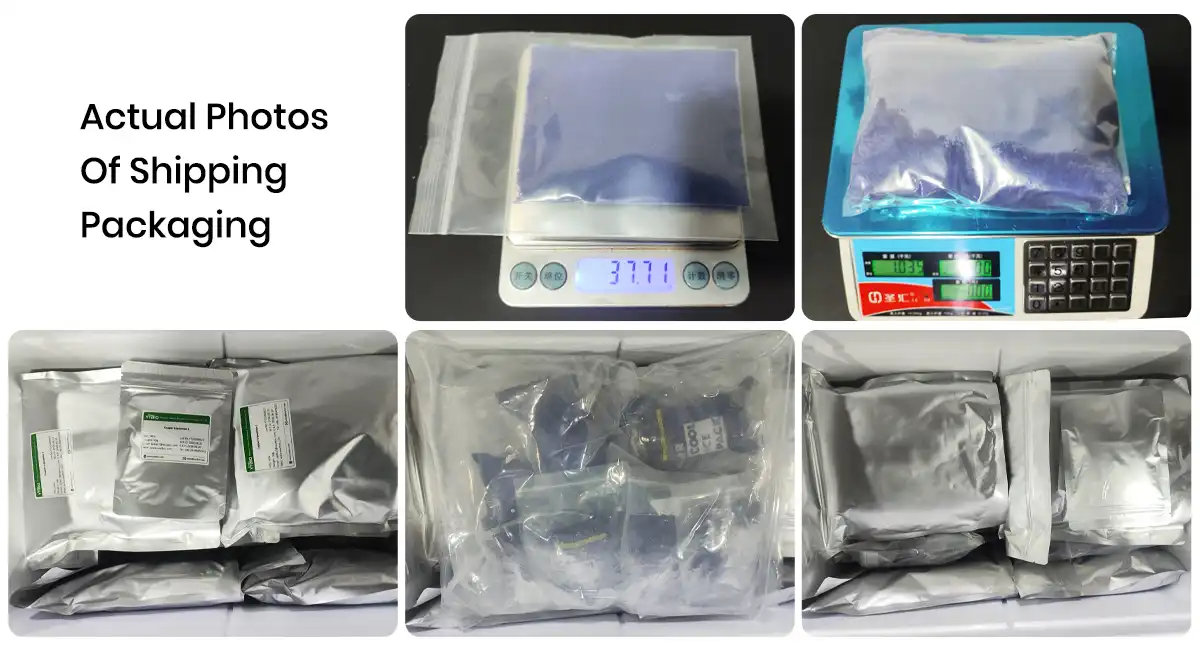
We offer flexible tiered supply from 1g samples to kilogram-level orders, with each shipment accompanied by a batch certificate of account (COA) and third-party testing support.
All production processes comply with international certifications such as cGMP, ISO22000, and KOSHER, ensuring batch traceability and transparent delivery.
Test Report
ITEM | STANDARD | TEST RESULT |
Assay by HPLC | 98% | 99.3% |
Appearance | Blue powder | Complies |
Odor & taste | Characteristic | Complies |
Mesh size | 100% pass100 mesh | Complies |
Loss on drying | ≤5.0% | 3.51% |
Residue on ignition | ≤1.0% | 0.36% |
Solubility | Soluble in water | Complies |
Identity by MS(GHK) | 340.5±1 | 340.6 |
Bulk density | ≥0.40gm/cc | 0.42gm/cc |
Heavy metals | ≥0.60gm/cc | 0.61gm/cc |
Heavy metals | ≤10PPM | Complies |
Arsenic | ≤1PPM | Complies |
Cadmium | ≤1PPM | Complies |
Total Plate Count | <1000cfu/g | 36cfu/g |
Yeast & Mold | <100cfu/g | 11cfu/g |
E.Coli | Negative | Complies |
S. Aureus | Negative | Complies |
Salmonella | Negative | Complies |
Mechanism of Action
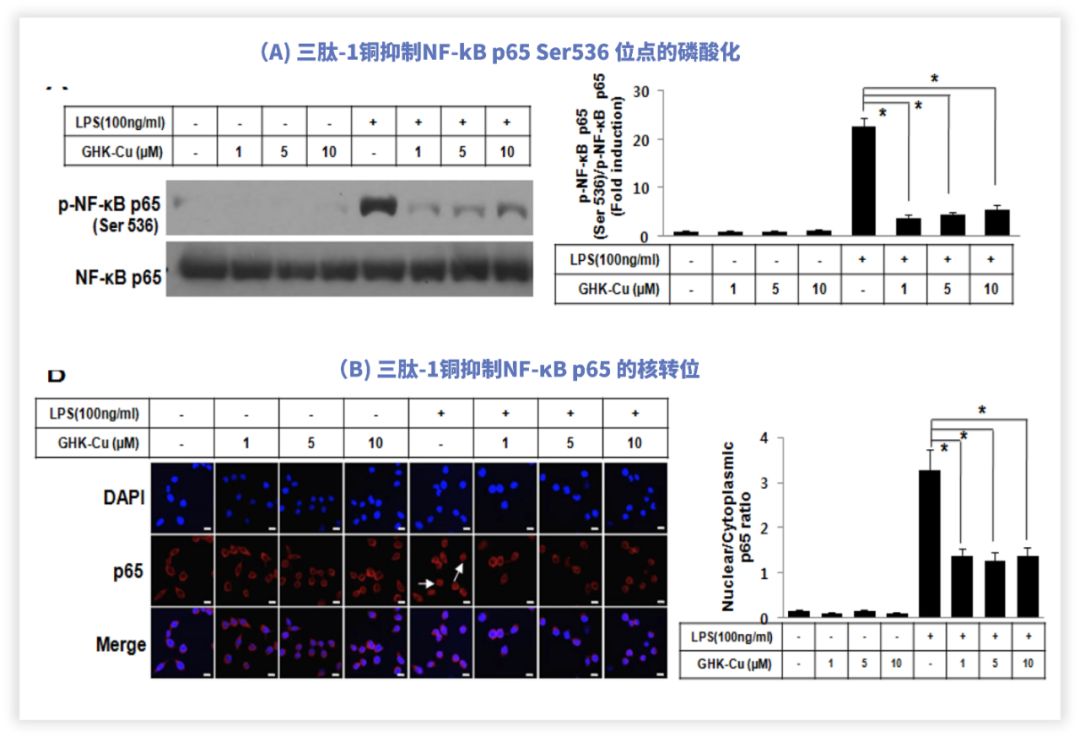
Studies have shown that copper tripeptide-1 can block the activation of the inflammation "master switch" NF-kB by inhibiting the phosphorylation and nuclear translocation of NF-κB p65 induced by external stimuli.
What does GHK Cu do?
Repair skin tissue and promote wound healing
GHK is a bioactive regulatory factor that naturally exists in the α2(I) chain of type I collagen in the extracellular matrix (ECM). It is released after skin injury and is an early signal for tissue repair. In addition, endothelial cells express a stromal cell-secreted glycoprotein, SPARC, which is degraded to produce GHK, which is considered to be one of the sources of GHK in serum.
Copper ions are trace elements required for various enzymatic reactions in the human body. The content of divalent copper ions in human plasma is about 1 μg/mL, more than 95% of which is present in ceruloplasmin, and the remaining 5% is with other Molecules (such as albumin, histidine, etc.) bind. Due to its high affinity for copper ions, GHK can antagonize other molecules, compete with them to complex copper ions, and serve as a carrier to deliver copper ions to the injury site to promote wound healing and tissue repair.
Epidermal stem cells exist in the basal layer and can differentiate into various cells in the skin when tissue is damaged, including fibroblasts, melanocytes, endothelial cells, etc. The loss of proliferation potential of epidermal stem cells is related to the reduction of integrin and p63 protein expression. Studies have found that GHK-Cu can significantly increase the expression of integrin and p63 protein, enhance the proliferation potential of epidermal stem cells, and enable them to better participate in tissue repair. process.
Promotes the synthesis of collagen and glycosaminoglycans (GAGs)
Copper Peptide GHK Cu Powder plays a physiological role in wound healing and tissue repair by stimulating collagen and glycosaminoglycans in fibroblasts. Biochemical analyzes were performed on rats injected with 2.0 mg of blue copper peptide (GHK-Cu) or phosphate-buffered saline control. Hydroxyproline and glucuronic acid were used as indicators of collagen and GAG content, respectively.
The results showed that throughout the experiment, injection of GHK-Cu significantly increased collagen content compared to the control on days 18 and 22 (396% and 538% compared to the control, respectively, p<0.05). GAG accumulation was significantly higher than controls on days 12, 18, and 22 (191%, 180%, and 179% of corresponding controls, respectively, p<0.05). Results showed that copper peptide (GHK-Cu) powder increased the synthesis of collagen and glycosaminoglycans in the skin.
Skin tightening
Copper Peptide GHK Cu Powder not only increases collagen, but also helps tighten the skin barrier and increase the density of collagen and elastin. Ultrasound scans were performed on the skin of a woman (59 years old) before treatment and on the same skin one month after treatment with a cream containing GHK copper powder. The white and yellow areas are ultrasound reflections from areas of skin that are denser due to cells being more tightly bound together and the amount of collagen and elastin being increased.
Reshape skin structure, resist aging and remove wrinkles
GHK-Cu can effectively enhance the functionality of fibroblasts and stimulate them to synthesize glycosaminoglycans, proteoglycans, collagen, elastin and other ECM components, thereby reshaping the skin structure.
In addition, GHK-Cu can also promote the expression of matrix metalloproteinases MMP-2, MMP-9 and their tissue inhibitors TIMPs. By regulating the activity of MMPs and TIMPs, GHK-Cu can help maintain the balance between matrix decomposition and synthesis, accelerate tissue remodeling, and improve the appearance of skin aging.
Antioxidant and anti-inflammatory
Immune cells use reactive oxygen species and other powerful oxidants to fight bacteria, so oxidative damage always accompanies inflammation. Relevant studies have shown that GHK-Cu can inhibit inflammation by reducing the levels of acute inflammatory cytokines such as TGF-β and TNF-α. In addition, by providing copper ions to tissues, GHK-Cu can increase the activity of superoxide dismutase, thereby inhibiting the generation of reactive oxygen species and achieving antioxidant effects.
Application of Copper Peptide in Cosmetics
Copper peptide GHK Cu tightens loose skin and improves elasticity. Improves skin density and firmness. Reduces fine lines and deep wrinkles. Improves skin clarity. Reduces photodamage and spot hyperpigmentation. Strongly increases keratinocyte proliferation. Blue copper peptide Kung can play multiple roles in the field of cosmetics and skin care, such as antioxidant, anti-inflammatory, anti-aging, anti-ethanol, etc. GHK copper powder is a good cosmetic raw material. Copper peptide GHK Cu powder is not only used for beauty and anti-wrinkle, but also has effects such as promoting hair growth and wound healing.
notes:
Avoid using strong acidic substances (A acid, high-concentration water-soluble L-VC), strong bases and strong oxidants together.
Avoid the use of ingredients that may form complexes with Cu ions, such as octanoyl hydroxamic acid preservatives, EDTA, carnosine, etc.
Avoid use with carbomer thickeners.
addition suggestions:
1. Wait for the formula system to drop below 40 degrees
2. When the pH is adjusted to 4.5-6.5, if it is too low or too high, it will cause the copper tripeptide-1 to decompose and change color.
3. It is recommended to add Tripeptide-1 copper solution last.
Contact Us
YTBIO is committed to providing customers with the highest-quality Pure Copper Peptide/GHK Cu Powder and services so that every consumer can enjoy natural, healthy, and high-quality food. If you have any inquiries or needs about our products, please feel free to contact us, and we will reply to you as soon as possible.
Tel:86-029-86478251 / 86-029-86119593
Whatsapp:8617782577059
Email:sales@sxytorganic.com
Hot tags:Copper Peptide GHK Cu Powder,China suppliers,manufacturers,suppliers,wholesale,buy,low price,price,for sale.