Retinaldehyde: The Next-Gen Retinoid for Premium Skincare Lines
Retinaldehyde powder is a groundbreaking new skincare ingredient that fills the gap between regular retinol and prescription-strength retinoic acid. This advanced aldehyde form of vitamin A is the most advanced anti-aging technology available. It is an excellent ingredient for next-generation formulas for high-end skincare brands and B2B procurement experts. As cosmetic companies across the globe look for softer but more effective alternatives to traditional retinoids, this product stands out as the best choice for high-end product lines aimed at picky customers who want both results and comfort.
Understanding Retinaldehyde Powder: Science and Benefits
Retinaldehyde powder is a complex retinoid that has a special place in the vitamin A conversion process. Retinaldehyde just needs one conversion step to create active retinoic acid, whereas regular retinol needs two. This makes retinaldehyde far more bioavailable and faster-acting than its predecessors.
The Scientific Foundation of Retinaldehyde Effectiveness
Retinaldehyde's molecular nature makes it easier for it to go through skin barriers while keeping formulations stable. Clinical investigations show that retinaldehyde speeds up the turnover of cells at rates similar to those of prescription tretinoin, but with far less chance of causing discomfort. The improved tolerance profile is due to its regulated conversion process, which lets active chemicals be released slowly instead of all at once as stronger retinoids do.
Key Benefits for Premium Skincare Applications
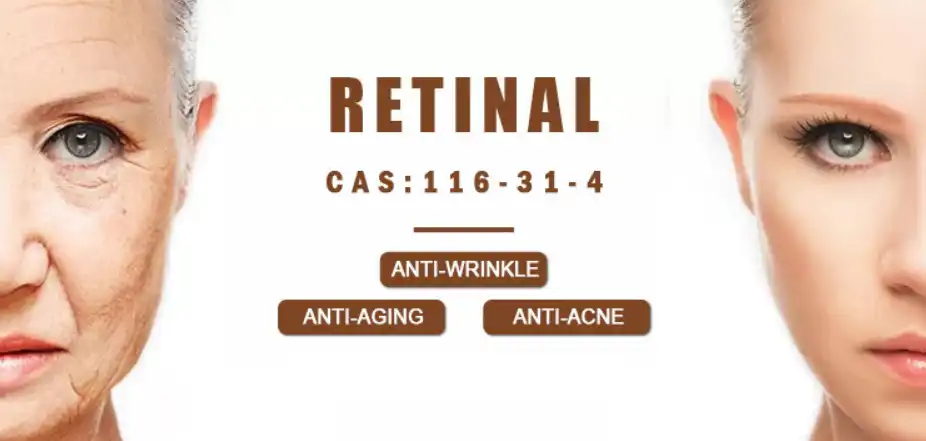
Skincare companies that include retinaldehyde powder to their products may provide customers a number of health advantages. The substance is great at boosting collagen production, smoothing out fine wrinkles, and making skin feel better by speeding up cell regeneration. Also, its ability to kill bacteria makes it very good for treating acne while also providing anti-aging effects. The powder form makes sure that the product is very pure and makes it easy to mix into a wide range of products, from light serums to thick moisturizing creams.
Comparing Retinaldehyde Powder with Other Retinoids: Choosing the Right Ingredient
People who make products and people who buy them need to know what makes retinaldehyde powder different from other retinoid compounds. This research helps you make smart decisions about the substances to employ, which will impact how well the product works and how well it sells.
Retinaldehyde vs. Retinol: Enhanced Potency and Tolerance
Retinol is still a common component in skin care products, but retinaldehyde powder performs better and is worth the additional money. Studies demonstrate that retinaldehyde changes into active retinoic acid around ten times faster than retinol. This implies that advantages that seem real come faster. Formulators may be able to obtain the results they seek with lesser dosages if they can convert more efficiently. This decreases the possibility of pain while yet preserving the health benefits.
Regulatory Advantages Over Prescription Alternatives
Retinaldehyde powder is not a prescription retinoid like tretinoin and other retinoids. Instead, it is treated as a cosmetic in all markets across the globe. This classification helps businesses access new markets and register their items, which is why it's a smart option for companies who want to sell their goods all over the globe. Because of its safety profile, the substance may be used without a prescription. It also offers clinical-grade results that satisfy consumers' expectations for high-end skincare products.
How to Use Retinaldehyde Powder in Skincare Formulations
When adding retinaldehyde powder, it's crucial to carefully consider the formulation factors to ensure that the product is as stable, effective, and pleasant for consumers as feasible. When producers know how to use an ingredient correctly, they can get the most out of its medicinal benefits and maintain the product's quality throughout time.
Recommended Concentration Ranges and Product Types
The ideal amounts of retinaldehyde powder depend on how the product will be used and who it is meant for. Most entry-level formulations contain concentrations between 0.05% and 0.1%. This is a good approach to start using retinoids for those with sensitive skin. Some high-end anti-aging medications may contain concentrations as high as 0.2%, which might help those who have taken retinoids previously get results faster. The molecules of the chemical may pass through serums, which is why they perform so effectively. It also works well in creams and lotions.
Stability Considerations and Storage Requirements
To keep retinaldehyde powder stable throughout manufacture and storage, certain environmental parameters must be met. The substance stays stable best when kept below 25°C in places where light can't get to it and there isn't much oxygen. To keep the active compounds from breaking down, the pH of the formulation should stay between 5.5 and 6.5. Choosing the right packaging, such as airless dispensers and containers that protect against UV light, greatly increases the shelf life of a product while keeping its therapeutic effects.
Procurement Strategies for Retinaldehyde Powder: What B2B Buyers Need to Know
To acquire high-quality retinaldehyde powder, you need to carefully choose your providers and apply clever shopping techniques. B2B buyers need to consider about more than simply pricing to make sure that the items maintain the same quality and that the supply chain runs smoothly.
Quality Assessment and Supplier Certification
Suppliers of high-quality retinaldehyde powder should have full quality management systems in place, such as GMP accreditation, ISO compliance, and strict purity testing procedures. Usually, acceptable levels of purity are above 98%, and there are extensive certificates of analysis that provide the impurity profiles and stability statistics. To make sure that the ingredients are safe from the time they are made until they are delivered, suppliers should provide proof of how they are made, how they are stored, and how they check for quality.
Bulk Purchasing Considerations and Logistics
Strategic procurement planning entails looking at factors like minimum order quantities, pricing structures, and delivery schedules to obtain the best value for your money. The best suppliers usually allow you buy in a method that works for both small-scale product development and large-scale commercial production. When you send products to other countries, you need to think about how to maintain the temperature perfect for the whole trip and how to fill out the proper customs forms to make sure you obey the laws for bringing things into other countries.
Embedding Retinaldehyde Powder into Your Premium Skincare Line: Company Introduction and Product Services
At YTBIO, we focus on making high-quality retinaldehyde powder that helps top skincare manufacturers make groundbreaking anti-aging products. Because we are dedicated to quality and innovation, cosmetic manufacturers can trust us to help them set their products apart with the newest retinoid technology.
YTBIO's Quality Standards and Certification Excellence
Our retinaldehyde powder meets the highest standards for quality across the world. It has all the necessary certifications, including ISO9001, USDA NOP organic certification, and EU organic certification. We have strong quality control methods in place throughout our supply chain to make sure that the levels of purity and stability in our ingredients meet the high criteria for premium skincare products. We are accredited by GAP, GMP, HACCP, and ISO, which implies that every batch meets international standards from the time it is made until it is sent.
Customized Solutions and Technical Support
YTBIO can provide different amounts and levels of purity of retinaldehyde powder to meet the needs of different OEMs and ODMs. Our technical team offers full formulation consultancy, assistance on stability testing, and regulatory support to make sure that product development goes smoothly. We know that high-end skincare companies need dependable partners, which is why we always have supplies on hand and are quick to respond to client questions. This helps you stay on track with your production and market launch deadlines.
Conclusion
Retinaldehyde powder is the most advanced form of retinoid, giving skin care companies a great chance to make high-quality products that work better and are easier on the skin. Its unique spot between retinol and pharmaceutical alternatives makes it perfect for firms who want to stand out in crowded marketplaces. The ingredient's established effectiveness, good regulatory status, and ability to be used in a variety of formulations make it a good choice for a wide range of products. As more and more people want anti-aging products that work but are also mild, retinaldehyde powder becomes an important part of skincare firms who are devoted to innovation and quality.
Frequently Asked Questions
Q1: Does retinaldehyde powder expire, and how should it be stored?
Q1: Does retinaldehyde powder go bad, and how should it be kept?A: Storage conditions free of light and moisture should keep retinaldehyde powder stable for at least 24 to 36 months. Although the powder is more stable than the liquid, it is still best to store it in airtight containers to extend its shelf life.
Q2: Can retinaldehyde powder be used safely for acne-prone and sensitive skin formulations?
A: Compared to other retinoids, retinaldehyde powder has a more regulated conversion process, making it less irritant to delicate skin. Its antimicrobial characteristics make it ideal for acne-prone skin, albeit the appropriate dosage may vary from person to person.
Q3: What is the difference between retinaldehyde powder and retinol powder in terms of effectiveness?
A: The rate of conversion of retinaldehyde powder to active retinoic acid is about ten times that of retinol. Reason being, unlike retinol, which needs two steps to become an enzyme, this one is simply one. It is now possible to create effective formulations at lower dosages because to improved bioavailability, which allows for faster results while still providing therapeutic advantages and reduces the risk of adverse effects.
Partner with YTBIO for Premium Retinaldehyde Powder Solutions
YTBIO's high-quality retinaldehyde powder for sale is made only for high-end cosmetics, so you may improve your skincare products. As a trustworthy provider of retinaldehyde powder, we help you every step of the way, from developing the product to making it available for sale. This way, your brand may get great results in today's competitive market. We are the best partner for companies who want to be innovative and great because of our technical knowledge, quality certifications, and dependable supply chain management. Are you ready to change your product line with the latest retinoid technology? To talk about your unique needs and ask for samples to try out, email us at sales@sxytorganic.com.
References
- Mukherjee, S., Date, A., Patravale, V., Korting, H. C., Roeder, A., & Weindl, G. (2006). Retinoids in the treatment of skin aging: an overview of clinical efficacy and safety. Clinical Interventions in Aging, 1(4), 327-348.
- Kang, S., Bergfeld, W., Gottlieb, A. B., Hickman, J., Humeniuk, J., Kempers, S., ... & Zheng, P. (2005). Long-term efficacy and safety of tretinoin emollient cream 0.05% in the treatment of photodamaged facial skin. Journal of the American Academy of Dermatology, 53(6), 1020-1026.
- Dréno, B., Bettoli, V., Araviiskaia, E., Sanchez Viera, M., & Bouloc, A. (2019). The role of topical retinoids in acne: an evidence-based review. American Journal of Clinical Dermatology, 20(3), 349-365.
- Shao, Y., He, T., Fisher, G. J., Voorhees, J. J., & Quan, T. (2017). Molecular basis of retinol anti-ageing properties in naturally aged human skin in vivo. International Journal of Cosmetic Science, 39(1), 56-65.
- Zasada, M., & Budzisz, E. (2019). Retinoids: active molecules influencing skin structure formation in cosmetic and dermatological treatments. Advances in Dermatology and Allergology, 36(4), 392-397.
- Kong, R., Cui, Y., Fisher, G. J., Wang, X., Chen, Y., Schneider, L. M., & Majmudar, G. (2016). A comparative study of the effects of retinol and retinoic acid on histological, molecular, and clinical properties of human skin. Journal of Cosmetic Dermatology, 15(1), 49-57.