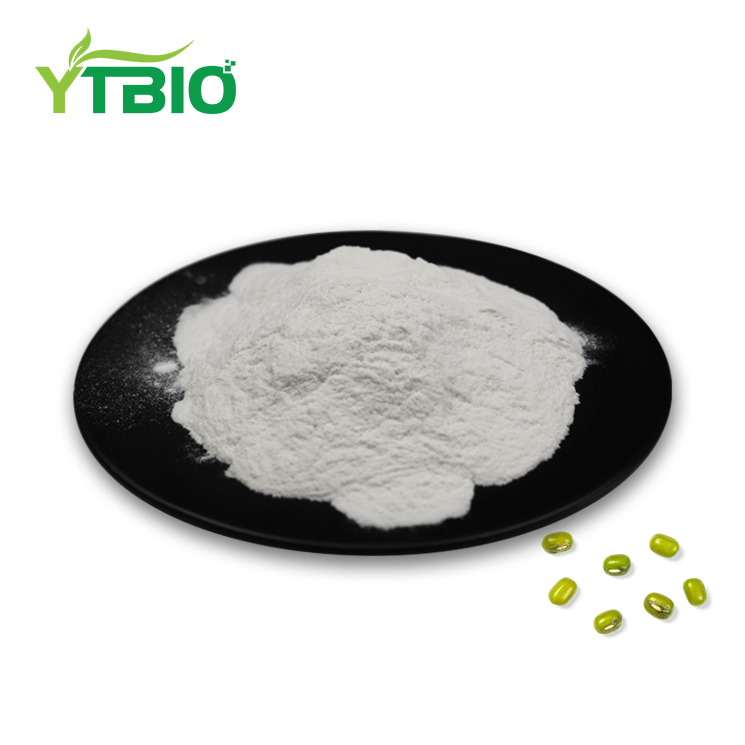
Mung Bean Starch Powder
Application: Excellent Nutritional Profile, Ideal for fortification, Dairy Alternatives, Bakery, Snacks, Meat......
Certifications : ISO22000 Kosher Halal FFSSC22000
Supply Capacity:50000kg
Shipping speed:1-3 days
Sample: Provided for free
Shipping method: DHL/FEDEX/UPS/EMS/TNT China
Inventory: In stock
MOQ:25KG
- Fast Delievery
- Quality Assurance
- 24/7 Customer Service
Product Introduction
Mung Bean Starch Powder:Introduction
 YTBIO supplies Mung Bean Starch Powder, made from non-GMO mung beans. Utilizing closed-loop separation and low-temperature airflow drying processes, it ensures batch stability in fineness (passing through an 80-120 mesh sieve), whiteness, and gel strength. The product is suitable for various pastries, meat products, and pharmaceutical excipients, and supports organic certification and customized mesh sizes.
Our mung bean starch is a fine, white to off-white powder with a delicate texture. After molding, it exhibits high transparency, good elasticity, and resistance to retrogradation. Naturally gluten-free, its dietary fiber content promotes intestinal motility and the growth of beneficial bacteria. In terms of processing properties, mung bean starch can be used as a thickener, stabilizer, and binder. It is also used as a pharmaceutical excipient in tablets and capsules.
| Test Item | Standard | Result |
|---|---|---|
| Color & Appearance | Meets product standard color | Complies |
| Form | White Fine Powder | Complies |
| Odor | Characteristic odor, no off-flavors | Complies |
| Active Content, % | ≥ 98.0 | 99.2 |
| Moisture, % | ≤ 15.0 | < 15.0 |
| Insoluble Matter, % | ≤ 0.6 | < 0.6 |
| Arsenic (As), mg/kg | ≤ 2.0 | < 2 |
| Lead (Pb), mg/kg | ≤ 5.0 | < 5 |
| Heavy Metals, mg/kg | ≤ 20 | < 20 |
| Total Plate Count, CFU/g | ≤ 1000 | Complies |
| Pathogenic Bacteria | Not detectable | Not detected |
What Are The Benefits?
Transparency: High transparency after gelatinization, resulting in crystal-clear foods.
Strength and Toughness: High amylose content, maintaining good texture even after prolonged cooking.
Low Water Absorption: Low water absorption, maintaining moisture balance and preventing foods from becoming too soft or crumbly.
Gloss: Pure white and glossy, giving foods a clean and attractive appearance.
Good Stability: Strong coagulation power, preventing deformation or collapse after shaping.
Health Benefits: Contains a certain amount of oligosaccharides, which help regulate gut microbiota.
Gluten-free: Naturally gluten-free, ideal for those with celiac disease, gluten allergies, or wheat allergies.
High fiber and protein: Neutral in taste and color, easy to add to a variety of foods without affecting their texture or appearance.
Sustainable and organic: Produced using sustainable organic farming methods, making it an environmentally friendly ingredient choice for sustainable businesses.
Why Choose Our Mung Bean Starch?
We strictly control the source of raw materials and production processes to ensure the stable and reliable taste and shaping effect of your processed products.
Our mung bean starch naturally contains oligosaccharides, which have potential health value in regulating gut microbiota and can be used to develop healthy functional foods.
Our mung bean starch, with its high transparency, strength, low water absorption, pure white gloss, and natural oligosaccharide advantages, ensures that the finished product does not fall apart after prolonged cooking and maintains its shape, while meeting microbiological and purity standards, fully satisfying your needs for food manufacturing and health foods.
Application Guide
Our mung bean starch is suitable for the food and health food industries, and can meet the comprehensive requirements of customers in different regions for taste, appearance and compliance.

| Application Area | Specific Use | Recommended Addition Level | Suitable Target Regions |
|---|---|---|---|
| Vermicelli, Noodles, Starch Sheets | Vermicelli, etc. | 90%-100% of raw material (pure mung bean starch) or blended with other starches (e.g., mung bean : potato = 7:3) | Southeast Asia, Japan, South Korea, Chinese communities |
| Liangfen, Liangpi, Mung Bean Cakes | Traditional Chinese snacks, desserts | Liangfen/Liangpi: Water:Starch = 5:1 to 8:1; Mung Bean Cakes: 20%-30% | Southeast Asia, Japan, South Korea, Middle East, Europe |
| Casings, Premium Meat Products | Dim sum, sausages, surimi products | 3%-8% (of total meat or surimi weight) | Japan, South Korea, High-end dining in Europe/America, Middle East |
| Health Foods | Diabetes-friendly foods, meal replacements, gut health products | 5%-20% (varies by formulation needs) | Europe, America, Australia, Japan |
| Industrial & Pharmaceutical (Binder, Filler) | Tablets, capsules, biodegradable packaging | 5%-15% (of total excipients or raw materials) | Europe, America, Japan |
Expanding Application Areas
Besides food processing, mung bean starch has wide applications in industry, chemical industry, and textiles.
I. Industrial Applications
Mung bean starch can be used as a binder, reinforcing agent, or filler in the preparation of environmentally friendly adhesives, biodegradable materials, papermaking additives, and building material auxiliaries. Furthermore, it can be used as a yarn sizing agent in textile-related industrial processes.
The specific dosage needs to be determined based on the formulation, process parameters, and target product. Common reference ranges are as follows:
Environmentally friendly adhesives: The ratio of starch to water is approximately 1:5 to 1:10.
Paper surface sizing or reinforcement: The addition amount is approximately 0.1% to 3% of the total mass of pulp or paper.
Building material auxiliary materials (such as plaster): The addition amount is approximately 0.5% to 2%.
Yarn sizing: The addition amount is approximately 1% to 5% of the yarn weight.
II. Chemical Industry
Mung bean starch can be used as a thickening component, suspending component, filler component, or carrier component in formulations for coatings, adhesives, detergents, inks, adsorbent materials, etc.
Common reference ranges are as follows:
* Coatings: Approximately 1% to 10%*
* Adhesives: Approximately 0.5% to 5%*
* Detergents: As an anti-redeposition component, the addition amount is usually no more than 1%*
* Inks: As a thickening component, the addition amount is approximately 0.5% to 2%*
* Adsorbents: Approximately 5% to 20% of the total adsorbent mass*
III. Textile Industry
 Mung bean starch has the following applications in the textile industry:
* Textile sizing agents: Used for sizing yarns, forming a uniform film structure on the yarn surface*
* Printing paste carriers: Used in textile printing and dyeing pastes*
* Fabric treatment agents: Used in related finishing processes
The specific dosage needs to be determined based on the textile material, treatment process, and auxiliary agent formulation requirements. Common reference ranges are as follows:
Yarn sizing: Add approximately 1% to 5% of the yarn weight.
Printing pigment: As a paste carrier, add approximately 3% to 5% of the total pigment mass.
Fabric treatment: A 1% to 3% starch solution can be used for application via padding or spraying.
Contact Us
For recommended dosages for your specific formulation, the latest pricing, and sample services, please feel free to contact our technical team for relevant information.
Tel:86-029-86478251 / 86-029-86119593
Whatsapp:8617782577059
Email:sales@sxytorganic.com
Hot tags:Mung Bean Starch Powder,pure Mung Bean Starch,China suppliers,manufacturers,suppliers,wholesale,buy,low price,price,for sale.