What is the difference between chicory inulin and Jerusalem artichoke inulin?
I. What is inulin?
Inulin is a naturally occurring water-soluble dietary fiber found in a variety of plants; it belongs to a class of compounds known as fructans. It is primarily composed of fructose units linked by β-(2→1) glycosidic bonds, with some molecular chains terminating in a glucose unit.
Inulin is widely distributed in plants such as chicory, Jerusalem artichoke, garlic, onions, and dandelions. Among these, chicory roots and Jerusalem artichoke tubers are the two most significant raw material sources currently used for the commercial production of inulin.
Although products extracted from both sources are classified as inulin, factors such as the plant species, growing environment, harvest timing, and extraction/processing methods can significantly influence the properties of the inulin. Consequently, chicory inulin and Jerusalem artichoke inulin cannot be simply regarded as identical products.
II. Chicory Inulin vs. Jerusalem Artichoke Inulin
1. Chicory: Extracted primarily from the roots
Chicory is a perennial herbaceous plant belonging to the *Cichorium* genus (Asteraceae family). Its roots are rich in inulin. Through a series of processes—including washing, slicing, hot-water extraction, filtration, purification, and drying—inulin powder derived from chicory can be obtained.
Chicory has long been the traditional raw material for the inulin industry in Europe. It benefits from well-established cultivation, processing, and supply chain systems, making it a common source of commercial inulin in the international market.
2. Jerusalem Artichoke: Extracted primarily from underground tubers
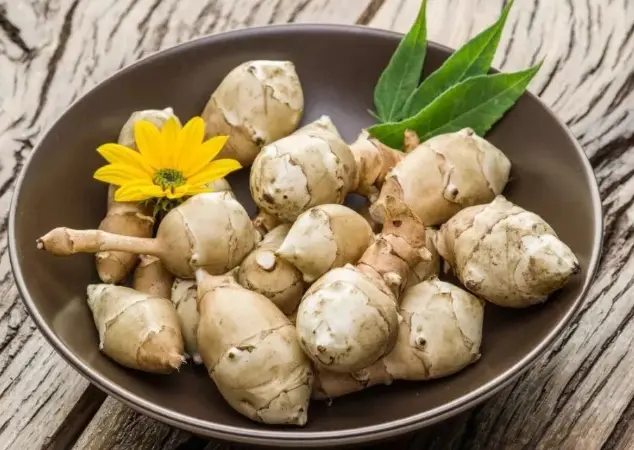
Jerusalem artichoke (also known as sunchoke) is a perennial herbaceous plant belonging to the *Helianthus* genus (Asteraceae family). Unlike chicory, the Jerusalem artichoke stores inulin primarily in its underground tubers. These tubers contain high levels of inulin, serving as another important natural source of the fiber.
 |
 |
III. What are the differences between chicory inulin and Jerusalem artichoke inulin?
The primary distinction between the two does not lie in whether they contain inulin, but rather in their source, which leads to differences in their composition and processing characteristics.
1. Plant Parts and Inulin Content
Inulin from chicory is primarily extracted from the plant's roots, while inulin from Jerusalem artichoke is derived from its underground tubers. Existing research indicates that both plants contain high levels of inulin on a fresh-weight basis.
|
Item |
Chicory |
Jerusalem Artichoke |
|
Botanical Name |
*Cichorium intybus* |
*Helianthus tuberosus* |
|
Part Used for Extraction |
Roots |
Tubers |
|
Inulin Content (Fresh Weight) |
Approximately 15%–20% |
Approximately 16%–20% |
|
Main Components |
Inulin-type fructans |
Inulin-type fructans |
|
Primary Uses |
Food, beverages, dietary fiber ingredients |
Food, beverages, dietary fiber ingredients |
2. Molecular Chain Length and Degree of Polymerization (DP)
This is a significant aspect to consider. The Degree of Polymerization (DP) of inulin refers to the number of monosaccharide units within its molecular chain. Inulin with varying degrees of polymerization may differ in terms of solubility, sweetness, viscosity, and performance during food processing.
- Chicory Inulin: Features a broad distribution of DP, with natural inulin containing both short-chain and medium-to-long-chain components. Through further separation, inulin products with specific chain lengths can be obtained.
- Jerusalem Artichoke Inulin: Also consists of molecules with varying degrees of polymerization; however, some studies suggest that its natural form has a relatively lower average DP, with a notable proportion of short-chain components.
Some research indicates that the average DP of natural chicory inulin is approximately 10–20, while that of Jerusalem artichoke inulin is generally lower. It should be noted, however, that these values can vary based on plant variety, maturity, and processing conditions.
3. Extraction Processes and Processing Characteristics
In industrial production, inulin from both sources can be processed using techniques such as water extraction, filtration, purification, concentration, and drying. Nevertheless, the specific processing approach is influenced by the nature of the raw material and production conditions.
Extraction Process for Chicory Inulin:
Typically, cleaned chicory roots are sliced or crushed to increase their surface area for contact with water, followed by hot-water extraction. The extract then undergoes filtration, decolorization, demineralization, concentration, and spray drying to yield inulin powder.
Extraction Process for Jerusalem Artichoke Inulin:
Typically, cleaned Jerusalem artichoke tubers are sliced or crushed, and the inulin is extracted using water. The resulting extract is then subjected to filtration, purification, concentration, and drying to obtain the final product.
It is important to note that inulin is a carbohydrate that is highly sensitive to temperature, pH levels, and processing duration. In particular, under unsuitable temperature or acidic conditions, hydrolysis may occur, leading to changes in the length of the molecular chains. Therefore, extraction and purification conditions must be carefully controlled during production to ensure consistent product quality.
4. Sensory Characteristics and Physicochemical Properties
The degree of polymerization (DP) distribution of inulin influences its performance within food systems; consequently, inulin from different sources or with different processing specifications may exhibit variations in sensory characteristics (mouthfeel/taste).
In general:
- Short-chain inulin: Tends to have a more pronounced sweet taste and better water solubility, making it suitable for food formulations that require both a degree of sweetness and a boost in dietary fiber.
- Long-chain inulin: Has a relatively lower level of sweetness. At certain concentrations, it can form a smooth, gel-like structure, often used to improve food texture, increase viscosity, or serve as a partial fat replacer.
It should be noted, however, that one cannot determine a product’s sweetness or solubility solely based on whether it is derived from chicory or Jerusalem artichoke. Actual performance is closely linked to factors such as the degree of polymerization distribution, purity, particle size, and the specific processing methods employed.
IV. Chicory Inulin vs. Jerusalem Artichoke Inulin: Which Is Better for Food Development?
Both types of inulin offer significant value for food applications. The choice between them should be based on the specific product formulation, processing conditions, and target physicochemical specifications.
For example:
- When developing high-fiber solid beverages, the focus should be on the inulin’s solubility, dispersibility, and sensory profile.
- When developing low-fat dairy products or plant-based foods, the focus may be on how inulin with varying degrees of polymerization affects the product's texture.
- When developing dietary supplements, the appropriate inulin can be selected based on the specific requirements for purity and degree of polymerization.
Ultimately, there is no absolute superiority of one over the other; the key lies in ensuring that the quality of the raw material aligns with the requirements of the final application.
Conclusion: From Raw Material to Application—Choosing the Right Inulin for Your Needs
YTBIO specializes in the supply of plant extracts, food ingredients, and raw materials for nutritional supplements. We provide comprehensive ingredient sourcing and one-stop OEM/ODM services for global food manufacturers, nutrition brands, and product developers. If you are looking for inulin ingredients for the development of food, beverages, or dietary supplements, please contact YTBIO to learn more about product specifications and customized partnership options.
Tel:86-029-86478251 / 86-029-86119593
Whatsapp:8617782577059
Email:sales@sxytorganic.com
References
[1] REDONDO-CUENCA A, HERRERA-VÁZQUEZ S E, CONDEZO-HOYOS L, et al. Inulin extraction from common inulin-containing plant sources[J]. Industrial Crops and Products, 2021, 170: 113726. DOI: 10.1016/j.indcrop.2021.113726.
[2] LI W, ZHANG J, YU C, et al. Extraction, degree of polymerization determination and prebiotic effect evaluation of inulin from Jerusalem artichoke[J]. Carbohydrate Polymers, 2015, 121: 315-319. DOI: 10.1016/j.carbpol.2014.12.055.
[3] Differences in physicochemical, rheological, and prebiotic properties of inulin isolated from five botanical sources and their potential applications[J]. Food Research International, 2024: 114048. DOI: 10.1016/j.foodres.2024.114048.
[4] LING W, WANG J, ZHENG X, et al. Studies on the extracting technical conditions of inulin from Jerusalem artichoke tubers[J]. Journal of Food Engineering, 2007, 79(3): 1087-1093. DOI: 10.1016/j.jfoodeng.2006.03.028.
[5] HUSSAIN S, RANDHAWA M A, RAKHA A, et al. Ultrasound-assisted extraction, quantification and characterization of inulin from agave, chicory and Jerusalem artichoke[J]. Scientific Reports, 2026, 16: 11713. DOI: 10.1038/s41598-026-43085-8.